

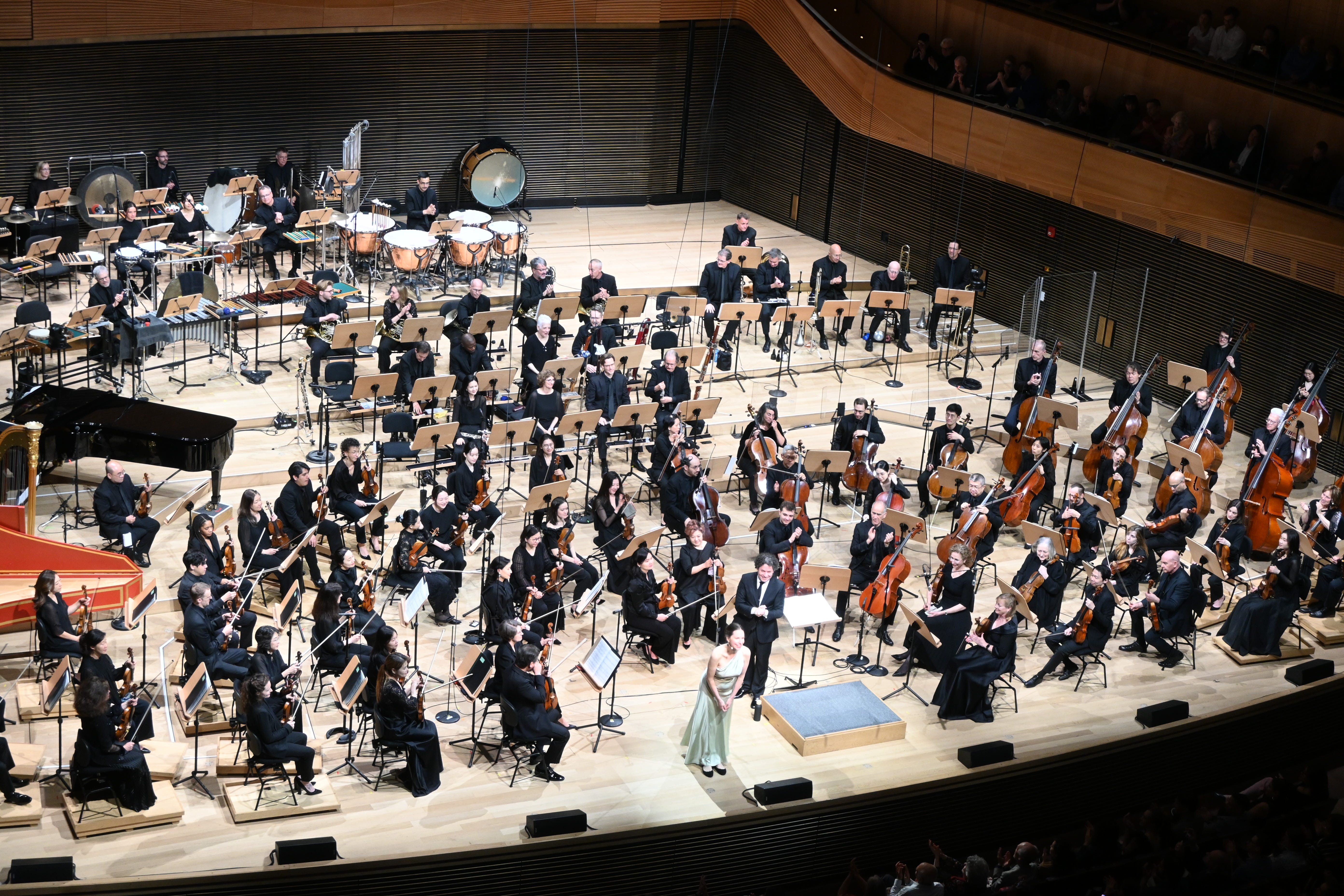
When I listened to soprano, Kate Soper, at the Lincoln Center in New York, it wasn’t just her voice and presence that made me feel inspired. It was like she sung from the Abyss. Her composition, Orpheus Opus Onus, was accompanied by the New York Philharmonic under the baton of Maestro Gustavo Dudamel and centered around the mythological figure of Orpheus, a legendary hero in Greek mythology. That night after the curtains closed, I understood that I had lived something more than a concert: I had lived what it meant to be a woman that could bring beauty from chaos.
Soper’s performance made me reflect about how music, writing, and education are like three companions who have walked together through the centuries—co-conspirators in their mission to elevate, to heal, and to ignite the human heart. In a world striving to hold onto hope, that night reminded me of the deeper purpose behind it all: to leave beauty in the world.
A line from the performance, spoken by Orpheus, carried a question that followed me all the way back home:
“Is that the point of all this [music]? A status symbol? A power trip? Or is it: to be in the presence of something sublime that has nothing to do with our trivial lives?”
Orpheus, in Greek mythology, is the musician who descended into the underworld to rescue his beloved Eurydice. He carried no weapons—only a song. His music moved gods and opened impossible gates. But, in the end, he failed. He looked back. He lost.
And yet, the music survived.
Orpheus was the artist who transformed sorrow into song and dared to cross the threshold even when the outcome was uncertain.
Soper steps into the unknown, like Orpheus, to make us feel what it means to be creatively alive. In a world where art has often been reserved for the privileged, Orpheus’s question becomes a call to our conscience.
I reached out to Soper a few weeks after that profound performance, moved by her ability to turn complexity into a song. I asked her for an interview to multiply the message behind her music.
She responded with kindness, humility and thoughtful presence. Soper was honest like her music. What follows is our conversation, part meditation and part interview on art, privilege, and the courage to compose from the unknown.
That moment in Orpheus — “a symbol, a status, a power” — was that question directed outward, inward, or both? What inspired that phrasing?
“It is a question both for myself and for the audience. I was wrestling with the conflict between the orchestra's power and beauty and its legacy as a tool of prestige for the wealthy and powerful, as well as its continued reputation as being only accessible (financially, culturally) to certain groups of people. I wanted to point out this complicated history and present it while also acknowledging that despite its institutional flaws, the orchestra has created so many transcendent works of art.’’
Beyond embracing the tension between the orchestra’s power and its beauty, Soper envisions music as a threshold. Do you believe that music — and art more broadly — can serve as a threshold to beauty, reflection, or hope for those who may have never felt invited into those worlds?
‘’Yes, I do believe that, and I try in my music -- as a composer, performer, and writer -- to make this threshold visible and help to draw people over it.’’
Soper’s answers made me reflect on what it would mean to ensure not just proper education, but artistic and creative beauty—real, accessible, dignifying beauty—in communities that have long been excluded from it.
What if we stopped treating the arts as a luxury, and instead honored them as a birthright? The following internal truths rise for me as I considered this very question:
Music is not a luxury; it is a seed.
Art is a spiritual right that belongs to all of us, regardless of ‘’social status’.
We can all compose our own world, not as an act of domain, but as an act of faith.
Composers like Kate help to open doorways into creative beautiful experiences. When asked, What would you say is the purpose behind your music? What calls you to compose, and what do you hope to awaken or plant in those who hear it? she described an important purpose behind her music.
“This is an enormous question…I think I can say that I'm called to compose in order to delve into certain complexities and conundrums about life and art that strike me as unresolvable. I hope that my music awakens a similar questioning nature in my audience and encourages them to challenge the artistic status quo.’’
If this article could carry a message from you to the women and girls in vulnerable communities who will read it — what would you like that message to be?
“I would say: Your questions about how the world works and about the culture you are a part of are valid. Your curiosities about the nature of things and about the ideas you have or that you encounter are worth exploring. And your perspective is valuable and will resonate with others, so don't listen to those who tell you otherwise, and take what opportunities you can to share it and strengthen it.’’
The questions I asked revolved around my thinking about women and girls who at some point felt they were not a part of the arts, its beauty and creative processes. How many of us were told that we could only create from safety? That we only deserved beauty when one has the means to its luxury, not as a right?
But Soper does not just speak from certainty. She speaks from curiosity. She doesn’t plant answers, she plants questions.
Her production, Orpheus Opus Onus, doesn’t offer easy answers. Instead, it invites us to sit in complexity — to feel, to tremble, to wake up.
And maybe, like Orpheus, we are invited to try again. Even after loss.
Even after facing your worst fear in the depths of the Abyss.
Because the act of composing, like living, is never about certainty.
It’s about courage in the Abyss.
Edición: Stephanie D., Freelance Editor and Creativity Coach | @the.quiet.desk | www.thequietdesk.com